Use Linq and Lambda Expression to Read the Number of Rows in Excel Range
The LAMBDA function provides a mode to create a custom function in Excel. Once defined and named, a LAMBDA function tin can exist used anywhere in a workbook. LAMBDA functions can be very unproblematic, or quite complex, stringing together many Excel functions into ane formula. A custom LAMBDA function does not require VBA or macros.
Case 1 | Case 2 | Example 3 | More than examples
In calculator programming, the term LAMBDA refers to an anonymous role or expression. An anonymous role is a function defined without a name. In Excel, the LAMBDA office is showtime used to create a generic (unnamed) formula. Once a generic version has been created and tested, it is ported to the Proper name Managing director, where it is formally defined and named.
Ane of the key benefits of a custom LAMBDA function is that the logic contained in the formula exists in just one place. This means at that place is just i copy of code to update when fixing problems or updating functionality, and changes will automatically propagate to all instances of the LAMBDA role in a workbook.
The LET function is oft used together with the LAMBDA role. Let provides a manner to declare variables and assign values in a formula. This makes more than complicated formulas easier to read by reducing redundant lawmaking. The Let function can too amend operation by reducing the number of calculations performed by a formula.
Creating a LAMBDA office
LAMBDA functions are typically created and debugged in the formula bar on a worksheet, then moved into the name manager to assign a proper noun that tin can exist used anywhere in a workbook.
There are four basic steps to creating and using a custom LAMBDA function:
- Verify the logic you lot will employ with a standard formula
- Create and test a generic (unnamed) LAMBDA version of the formula
- Name and ascertain the LAMBDA formula with the proper name manager
- Call the new custom function with the defined name
The examples below discuss these steps in more detail.
Example one - basic case
To illustrate how LAMBDA works, let'due south begin with a very simple formula:
In Excel, this formula would use typically use cell references similar this:
=B5*C5 // with cell references

As you lot can come across, the formula works fine, so we are ready to movement on to creating a generic LAMBDA formula (unnamed version). The first thing to consider is if the formula requires inputs (parameters). In this case, the answer is "yes" – the formula requires a value for x, and a value for y. With that established, we kickoff off with the LAMBDA function, and add the required parameters for user input:
= LAMBDA (x,y // begin with input parameters
Next, we demand to add the actual adding, x*y:
If you lot enter the formula at this point, y'all'll get a #CALC! error. This happens considering the formula has no input values to work with since in that location are no longer any prison cell references. To examination the formula, we demand to apply a special syntax similar this:
= LAMBDA (10,y,x*y)(B5,C5) // testing syntax
This syntax, where parameters are supplied at the end of a LAMBDA role in a split up fix of parentheses, is unique to LAMBDA functions. This allows the formula to be tested directly on the worksheet before the LAMBDA is named. In the screen below, you can see that the generic LAMBDA function in F5 returns exactly the aforementioned result equally the original formula in E5:

We are now set to proper name the LAMBDA part with the Name Manager. First, copy the formula, not including the testing parameters at the end. Adjacent, open the Name Manager with the shortcut Control + F3, and click New.

In the New Proper noun dialog, enter the name "XBYY", leave the scope set up to workbook, and paste the formula you copied into the "Refers to" input surface area. (Tip: Use the tab key to navigate to the "Refers to" field).

Brand sure the formula begins with an equals sign (=). Now that the LAMBDA formula has a proper name, it can be used in the workbook like any other function. In the screen below the formula in G5, copied down, is:
The screen beneath shows how things look in the workbook:

The new custom role returns the aforementioned issue as the other two formulas.
Example 2 - volume of sphere
In this example, nosotros'll catechumen a formula to calculate the book of a sphere into a custom LAMBDA function. The general Excel formula for calculating the volume of a sphere is:
= 4 / 3 * PI () *A1^ 3 // volume of sphere
where A1 represents radius. The screen below shows this formula in action:
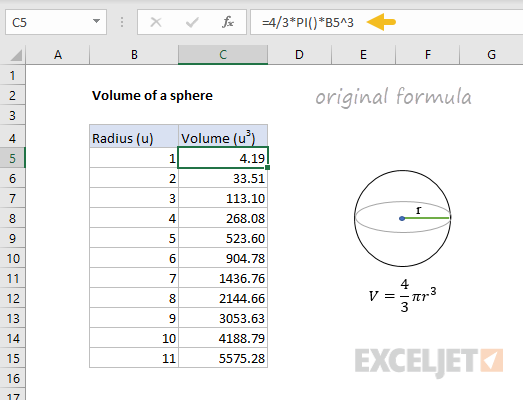
Discover this formula only requires one input (radius) to calculate volume, so our LAMBDA function will only need i parameter (r), which will announced as the get-go argument. Here is the formula converted to LAMBDA:
= LAMBDA (r, four / 3 * PI () *r^ 3 ) // generic lambda
Back in the worksheet, we've replaced the original formula with the generic LAMBDA version. Notice we are using the testing syntax, which allows u.s. to plug in B5 for radius:
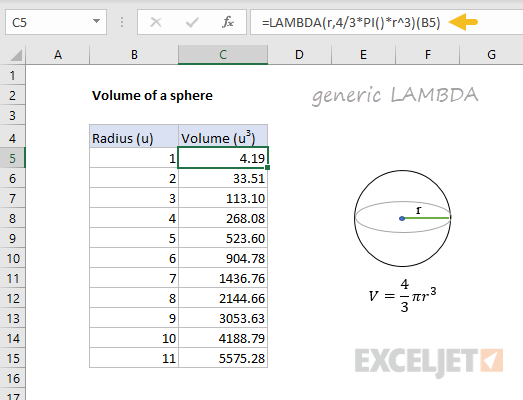
The results from the generic LAMBDA formula are exactly the same equally the original formula, so the next step is to define and name this LAMBDA formula with the Name Managing director, every bit explained above. The name used for a LAMBDA function tin be any valid Excel name. In this case, we'll name the formula "SphereVolume".
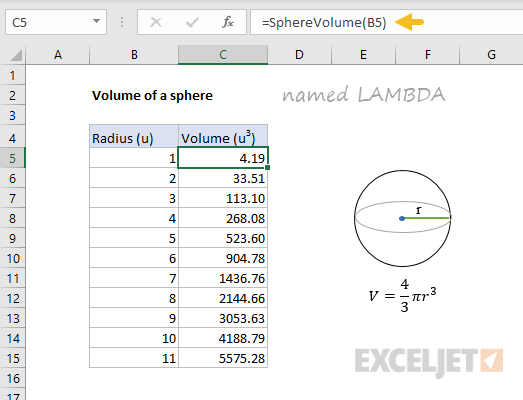
Back in the worksheet, nosotros've replaced the generic (unnamed) LAMBDA formula with the named LAMBDA version, and entered B5 for r. Notice the results returned by the custom SphereVolume part are exactly the same as previous results.
Example 3 - count words
In this example, we'll create a LAMBDA function to count words. Excel doesn't take a function for this purpose, but you can count words with a cell with a custom formula based on the LEN and SUBSTITUTE functions like this:
Read the detailed caption here. Here is the formula in action in a worksheet:
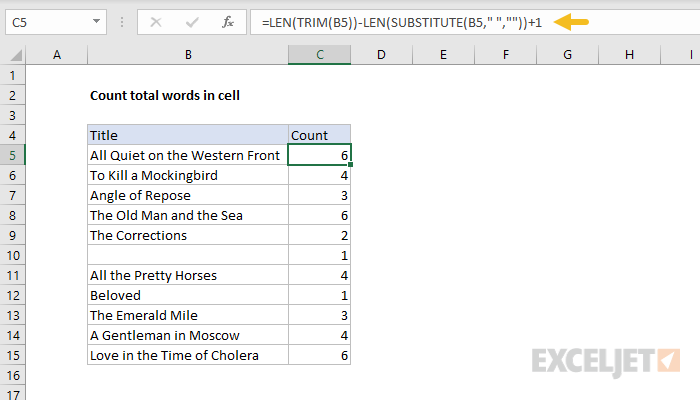
Detect we are getting an wrong count of i when the formula is given an empty cell (B10). Nosotros'll address this problem below.
This formula but requires 1 input, which is the text that contains words. In our LAMBDA office, nosotros'll proper name this argument "text". Here is the formula converted to LAMBDA:
Find "text" appears as the first statement, and the calculation is the 2d and terminal statement. In the screen below, nosotros've replaced the original formula with the generic LAMBDA version. Notice we are using the testing syntax, which allows u.s. to plug in B5 for text:
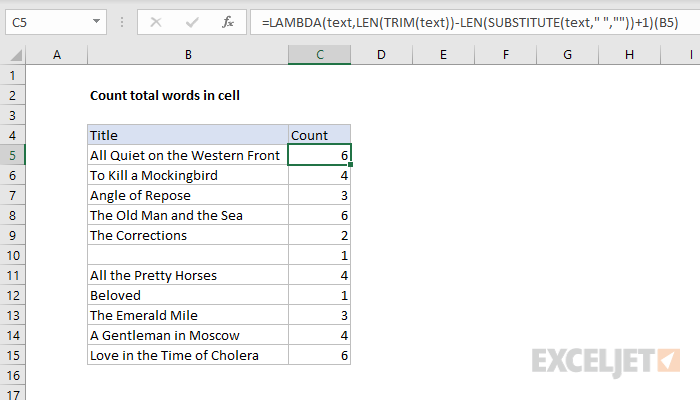
The results from the generic LAMBDA formula are the same equally the original formula, so the next step is to define and name this LAMBDA formula with the Proper noun Manager, as explained previously. We'll name this formula "CountWords".
Below, we've replaced the generic (unnamed) LAMBDA formula with the named LAMBDA version, and entered B5 for text. Notice we get exactly the same results.
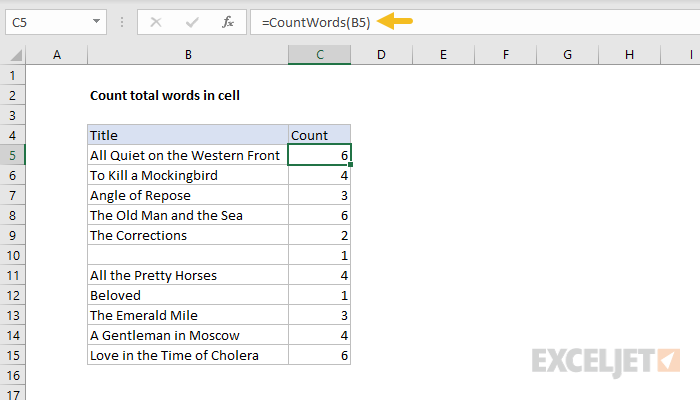
The formula used in the Name Managing director to define CountWords is the same as in a higher place, without the testing syntax:
Fixing the empty cell problem
As mentioned above, the formula above returns an incorrect count of 1 when a jail cell is empty. This problem can exist fixed by replacing +1 with the code below:
Total caption here. To update the existing named LAMBDA formula, we again demand to utilise the Name Managing director:
- Open up the Name Manager
- Select the proper noun "CountWords" and click "Edit"
- Supercede the "Refers to" lawmaking with this formula:
Once the Name Director is closed, the CountWords works correctly on empty cells, every bit seen below:
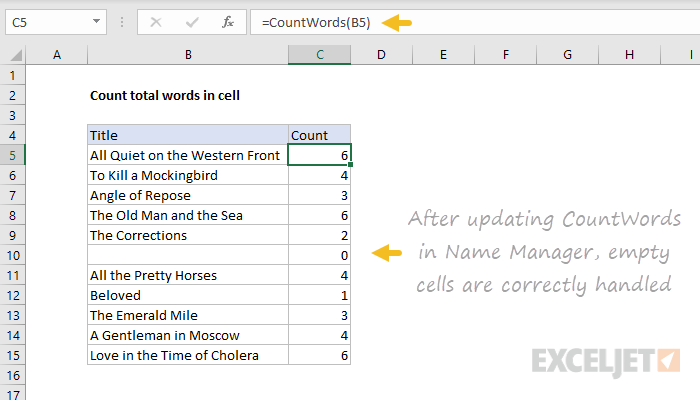
Annotation: by updating the code once in the Name Manager, all instances of the CountWords formula are updated at once. This is a central do good of custom functions created with LAMBDA –formula updates can be managed in ane place.
LAMBDA is a new function available in Excel 365 only.
Source: https://exceljet.net/excel-functions/excel-lambda-function
0 Response to "Use Linq and Lambda Expression to Read the Number of Rows in Excel Range"
Post a Comment